These robust, ready-to-use classroom lessons offer breadth and depth, spanning essential social justice topics and reinforcing critical social emotional learning skills.
This lesson challenges students to analyze and to reflect on messages presented in songs — and to express their own views about important issues addressed in some songs.
Almost every teacher has heard students use the expression, “that’s so gay” as a way of putting down or insulting someone (or to describe something). These lessons will help students examine how inappropriate language can hurt, and will help them think of ways to end this kind of name-calling.
This lesson centers on the invaluable work and activism of Bayard Rustin. Rustin was not only dedicated to orchestrating the civil rights movement; he was also one of Dr. Martin Luther King Jr.’s closest advisors, and the organizer of the 1963 March on Washington.
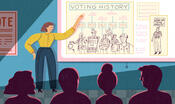
This lesson is the fourth in a series called Expanding Voting Rights. The overall goal of the series is for students to explore the complicated history of voting rights in the United States. Two characteristics of that history stand out: First, in fits and starts, more and more Americans have gained the right to vote. Second, over time, the federal government's role in securing these rights has expanded considerably.
In this lesson, students learn about the expansion and restriction of voting rights in the United States, examine court rulings, discuss voter disengagement, and explore a voting rights timeline. Students will also learn how to register to vote.
In this lesson, students will address misconceptions they likely have about Christopher Columbus and the colonization of what is now the United States.
In this lesson, students explore the varied work of scientists, technologists, engineers and mathematicians, and discuss character traits common to all of them. Students meet a diverse group of scientists—inventors, problem-solvers and those who explain the world around us.