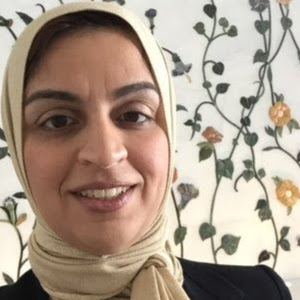
Sarah Said is a Middle Eastern daughter of immigrants from the southwest suburbs of Chicago. Currently, she lives in the suburbs west of Chicago. She is one of the founding administrators of an Expeditionary Learning school, the Elgin Math and Science Academy (EMSA), close to 40 miles west of Chicago. A mother of three children herself, Sarah serves as the school’s director of language and equity programs. In this role, she oversees the school’s Multilingual Learning program and supports the school’s equity frameworks. Sarah has strong beliefs in school-to-family connections and demonstrates
Marian Dingle is a veteran classroom elementary educator of 21 years. Always passionate about mathematics, her early career involved advocating for marginalized students and families. More recently, she has moved toward public advocacy, activism and scholarship, fascinated by the intersection of mathematics and social justice. She has been a member of Building Leadership Teams, led grade level teams, serves on her district mathematics committee, the state mathematics advisory committee, and is on the executive committee of the Georgia Council of Teachers of Mathematics. Mentoring new teachers
Maia Ferdman (she/her) is the staff director of the UCLA Dialogue Across Difference Initiative and deputy director of the UCLA Bedari Kindness Institute. She is also the founder of Bridges Intergroup Relations Consulting, a firm that supports organizations and communities to build vibrant spaces of belonging – celebrating our complex identities, proactively exploring our differences, and fostering resilient relationships between groups. Maia has worked with and consulted for agencies and organizations including the California State Water Boards, the City of Los Angeles, Pepperdine University
Rethinking the Region: New Approaches to 9-12 U.S. Curriculum on the Middle East and North Africa—a free, online curricular resource—needs to be on your radar. Learn about this resource from two of its co-authors.
Many students are constantly tied to their phones. As educators, we can tap into that interest—and students’ curiosity and desire for entertainment—to show them gateways to a wider worldview.
This lesson helps students explore, confront and deconstruct stereotypes targeted at Muslims. Students will learn about the impact of Islamophobia and create an anti-Islamophobia campaign to display in school.
Every time a new study is released showing black students are suspended at far higher rates than any of their peers, the public seems shocked. Words like “race” and “school to prison pipeline” and “discrimination” find their way into headlines—and then the issue fades away yet again.