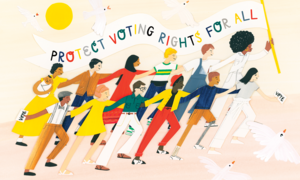
Uncovering the honest history of voting rights in the U.S. is crucial to create an inclusive society and realize the democratic ideals expressed in the Constitution.

Responsible parent and caregiver groups are focusing on children’s right to inclusive and equitable education—in direct opposition to politically motivated “parents’ rights” groups with discriminatory agendas that harm young people.
During this time of political and social turmoil, build networks of trusted adults to help young people understand, contextualize and counter manipulative and harmful information.
These design principles developed by the CODA panel are meant to provide guidelines for action to those selecting or developing strategies to improve intergroup relations.
"Hope, Despair and Memory" is an address given by Elie Wiesel on December 11, 1986, the date Wiesel was awarded the Nobel Peace Prize. Wiesel is an author and humanitarian and is known for writing about his experience as a survivor of the Holocaust.
The Teaching Tolerance staff reviews the latest in culturally aware literature and resources, offering the best picks for professional development and teachers of all grade levels.
This lesson focuses on questions of justice and the role youth have played in social and political movements. By reading a combination of primary and secondary sources, students will learn how the Little Rock Nine came to play their important role. These teenagers’ participation in school integration stemmed not from the prodding of the parents or activists, but from within themselves.