Search


Type
Grade Level
Social Justice Domain
Subject
Topic

2,176 Results

text
Literature

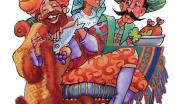
Eat, My Fine Coat!

Which are you more likely to notice: a person’s character or his or her clothing? Hoca has a witty response when the latter is true at a dinner he attends after a day of hard work.
by
Barbara Walker
Grade Level
Topic
Social Justice Domain
July 3, 2014
article

Ethnicity Check Goes Outside the Box

I recently served as a reader of scholarship applications. The process included a complex algorithm for inclusion and took several criteria into account, like GPA, test scores, native languages, income level, assets, essays, parental education level and ethnicity. While providing this service, I came face-to-face with a misconception about race and ethnicity: Appearance predicts what language people speak.
author

Anoa Changa

Anoa J. Changa (she/her) is a southern-based movement journalist and retired attorney. She previously served as a grassroots digital organizer and strategic advisor to several organizations. As a journalist, Anoa is deeply influenced by grassroots-led electoral organizing efforts. She approaches coverage through a lens that centers on impacted communities and moving beyond the status quo. Anoa follows in the footsteps of Black journalists like Ida B. Wells-Barnett, who leveraged the power of the media to uphold justice, defy white supremacy and expand access to democracy. Anoa is also the host
text
Informational

I Didn't Know There Were Cities in Africa: Challenging Children's-and Adult's-Misperceptions about the African Continent

In her article, Randolph delineates the profound impact of perpetuating stereotypical representations of Africa and its people by arranging them into three levels and then providing recommendations for how to combat them when creating learning experiences for students in the United States.
by
LFJ Staff
Grade Level
Topic
Subject
History
Geography
Social Justice Domain
September 28, 2018
article

Race Conversation Must Go Deeper

When I was in fifth grade and new to suburbia, my teacher introduced the concepts of racism, civil rights and fairness. And she began the task of helping 10-years olds—all of us white—learn how to talk about race in constructive ways. I’d moved from a gritty urban neighborhood where whites, blacks and Puerto Ricans lived together rather warily. My parents maintained a chilly silence on the issue of race, although they forbade racial epithets; on the street I heard plenty. In this place, the black kids came mostly from the projects, the Puerto Ricans lived in apartments and the better-off among the white families might have an entire house. I knew that race divided.