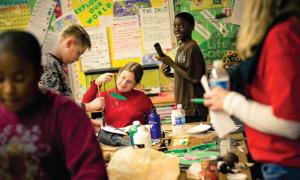
As part of our series highlighting educator voices, we spoke to five Black teachers who teach in predominately Black or all-Black settings to ask how they approach the topic of slavery.
This former high school history teacher now realizes that she failed her students by sticking to the subject matter and neglecting what’s most important about education. She’s worried her fellow educators might be failing too.
Students will describe the roles that slavery, Native nations and African Americans played in the Revolutionary War. Maps to Key Concepts 2, 3, 5, 9 & 10 What else should my students know? 5.A The Declaration of
In this activity, students will read about local history projects designed to foster connections between the town they live in and the enslaved people whose labor built it. Then, they will use primary sources to research the hidden history of their community.
This elementary school teacher hopes that the president can visit her school to see and learn about a different strategy for keeping our children safe.
Gov. Orval E. Faubus of Arkansas delivered this speech on Sept. 18, 1958. In this speech, Faubus justifies his decision to shut down Little Rock’s public high schools for the year rather than complying with the Supreme Court’s order to continue with integration.
In this article, Disability Rights and Resources outlines appropriate behavior, conversational cues, and common courtesies to internalize and enact when spending time with a person with a disability.
In third grade, Julia Horsman’s entire science project consisted of being herded outside with the other kids with disabilities and rolling soda cans down a ramp.